Donations from abroad

The TG-Programme supports German non-profit organisations in the acquisition of donations from other European countries.

German non-profit organisations can register in the TGE network as recipient partners in order to make it easier for their donors from other European countries to donate.

Transnational Giving (TG)

  •     Informs the organisation about the requirements
  •     Provides registration forms
  •     Sends the registration to the network partner

The TGE-Network has established itself as a suitable instrument for international donation campaigns.

For this purpose, it created a new online portal in 2020, through which organisations can manage their profiles, submit applications, renew their documents regularly and announce changes.

Are you responsible for a charity organisation and would you like to give your European donors an easy way to make a tax-deductible donation?

>> Information on the registration process
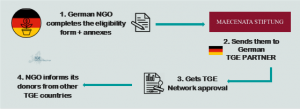
Diagram How does it work Beneficiaries 0819

FREE DONATION SHARE

To cover the expenditures and to further develop the network, part of the donation is retained as a free donation share: 5% of the first 100,000 EUR, then 1% up to a maximum of 50,000 EUR per donation (as of December 2020). Of this, the TGE network receives 1/5 and the two country partners involved each receive 2/5.

In the case of payments outside the SEPA area, any bank charges will be deducted from the donation. (For transfers to countries outside the euro area, different fees apply depending on the recipient bank.)

Donation receipts are issued for the full donation amount.

Kontakt

Marie-Christine Schwager-Duhse und Team
tg@maecenata.eu
+49 30 283 879 10-10

Monthly Information

.

Current articles on the topic:

  • The Shrinking Space of Civil Society: a Report on Trends, Responses, and the Role of Donors

    Opusculum 128 | 01.04.2010 | Civil society is one of the main arenas of the democratization. However, in recent years the political space of civil society has become narrower and does not contribute to effective operation of civil society organisations (CSOs). Due to repression by governments, civil society organisations are encountering a series of challenges, which may extend to closing down the organisations. 
  • Based on need alone? Impartiality in humanitarian action

    Opusculum 121 | 05.10.2018 | This collection of texts that examines how the core humanitarian principle of impartiality is dealt with in theory and in practice, and each author develops the theme in a different way. The essays seek to build a bridge between research and practice on the one hand, and between the international discussion and the debate in Germany on the other.
  • The Role of Civil Society in the Tunisian Transformation Process

    Opusculum 122 | 01.11.2018 | Political transformation scholars identified a new object of research through the course of the so-called “Arab Spring” that began in 2010 -the democratization of Arab countries. In Tunisia it resulted in a dmeocratic system. Simon Rothers investigates the importance and role of civil society during the transformation process in Tunisia
  • The Role of Foundations in German Higher Education

    Opusculum 85 | 01.08.2015 | A Case Study on the Influence of Foundations on Teaching at Universities    Executive Summary The need for a change in […]