Donations from abroad

The TG-Programme supports German non-profit organisations in the acquisition of donations from other European countries.

German non-profit organisations can register in the TGE network as recipient partners in order to make it easier for their donors from other European countries to donate.

Transnational Giving (TG)

  •     Informs the organisation about the requirements
  •     Provides registration forms
  •     Sends the registration to the network partner

The TGE-Network has established itself as a suitable instrument for international donation campaigns.

For this purpose, it created a new online portal in 2020, through which organisations can manage their profiles, submit applications, renew their documents regularly and announce changes.

Are you responsible for a charity organisation and would you like to give your European donors an easy way to make a tax-deductible donation?

>> Information on the registration process
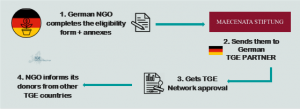
Diagram How does it work Beneficiaries 0819

FREE DONATION SHARE

To cover the expenditures and to further develop the network, part of the donation is retained as a free donation share: 5% of the first 100,000 EUR, then 1% up to a maximum of 50,000 EUR per donation (as of December 2020). Of this, the TGE network receives 1/5 and the two country partners involved each receive 2/5.

In the case of payments outside the SEPA area, any bank charges will be deducted from the donation. (For transfers to countries outside the euro area, different fees apply depending on the recipient bank.)

Donation receipts are issued for the full donation amount.

Kontakt

Marie-Christine Schwager-Duhse und Team
tg@maecenata.eu
+49 30 283 879 10-10

Monthly Information

.

Current articles on the topic:

  • Good luck, Brits! A message from Germany

    Britain will need time to reflect on what has happened – to adjust to the many changes brought about by Brexit, and to prepare for all the challenges that still lie ahead. At the Munich Security Conference, the UK government was hardly visible. If this is what is meant by ‘taking back control’, and if Britain uses its new position to look inward rather than outward, that is an alarming prospect indeed, given all the common security and defence challenges at play.
  • Colombia’s Negative Peace – A Challenge for Civil Society? A Dossier on the Struggle of the Global South with its Heritage and Post-Modernization


    Opusculum 130 | 01.02.2020 | This dossier is about Colombia’s current status of the peace contract, what has been accomplished, and what remains to be done; about conflict lines and reconciliation strategies; about how peace researchers, journalists and human rights workers assess the situation; and about peace-making efforts of civil society in Colombia and Germany.
  • The King, Religion, the State, and Civil society in Morocco: Can Think Tanks Help?

    Opusculum 133 | 01.02.2020 | Hind Arroub on the relationship between politics and religion in Morocco and how it is framed by the monopoly and religious dominance of the monarchy. Is there any space, albeit a narrow one, for Moroccan civil society to participate in shaping religious policy?
  • Feminist Philanthropy

    More funding for ‘women and girls’ is necessary but not sufficient. What philanthropy really needs is a feminist consciousness – a vision which places women’s rights front and centre, challenges political norms and economic orders, shifts power to the most marginalised and interrogates the social construction of gender.